
e-CMR in 2026: where the electronic consignment note is valid and what it takes to be accepted
The e-CMR, the electronic CMR consignment note, is lawful in 42 countries in 2026, including Ukraine, Poland, Moldova, Romania, Türkiye and most of Central Asia. But lawful does not mean mandatory, and a photo or PDF on a phone is not an e-CMR. Here is what the 2008 Protocol says, what it takes for an electronic note to be recognised, from when EU authorities must accept electronic freight data under the eFTI Regulation, and why a paper CMR still belongs in the cab.
 Moisa Logistics··7 min read
Key figures
In short: is the e-CMR valid
Yes, between countries that joined the Protocol. The Additional Protocol to the CMR Convention concerning the Electronic Consignment Note (Geneva, 20.02.2008) has been in force since 05.06.2011 and now has 42 parties. An electronic consignment note made out under the Protocol has the same evidentiary value as the paper one (Art. 2). But it is optional: it works only when the sender, the carrier and the consignee have agreed to it and keep it on a platform with a reliable electronic signature.
- A photo, scan or PDF of a paper CMR is not an e-CMR - it is a copy.
- No party to the Protocol is obliged to switch carriers to electronic notes.
- From 09.07.2027 authorities in EU countries must accept freight data made available through certified eFTI platforms (Regulation (EU) 2020/1056). This is about enforcement, not about the contract of carriage.
- Keep a paper CMR in the cab as a fallback for now.
What an e-CMR is, and what it is not
An e-CMR is a CMR consignment note issued as an electronic communication by the carrier, the sender or another party interested in the performance of the contract, and authenticated by the parties with an electronic signature (Arts. 1 and 3 of the Protocol). The Convention itself does not change: the electronic note carries the same particulars as the paper one under Art. 6 of the Convention (Art. 4(1) of the Protocol), and the rules on reservations, delivery and claims apply as before. Other communications under the contract - the sender’s instructions, the carrier’s reservations, confirmation of delivery - may also be electronic (Art. 2(1)).
What is not an e-CMR:
- A photo or scan of a paper note sent by messenger. It is a copy: the second original of a paper CMR travels with the goods (Art. 5 of the Convention).
- A PDF from software without the parties’ electronic signatures and without agreed procedures. You print and sign it - and then it is an ordinary paper CMR.
- Ukraine’s e-TTN. That is the consignment note for domestic haulage in Ukraine, kept in a state system and unrelated to the e-CMR Protocol. More in “Ukraine’s e-TTN: mandatory from 2027 or not”.
Where the e-CMR applies: Ukraine, Poland, Moldova, Türkiye and others
As of 21.11.2026 the Protocol has 42 parties (status in the UN Treaty Collection). For each country it enters into force on the ninetieth day after that country deposits its instrument of accession (Art. 8(2)). Countries on the routes our clients drive:
| Country | Joined (instrument deposited) | Protocol in force from |
|---|---|---|
| Ukraine | 10.07.2020 | 08.10.2020 |
| Poland | 13.06.2019 | 11.09.2019 |
| Moldova | 14.03.2018 | 12.06.2018 |
| Romania | 14.03.2019 | 12.06.2019 |
| Hungary | 28.08.2024 | 26.11.2024 |
| Slovakia | 21.02.2014 | 22.05.2014 |
| Czechia | 14.04.2011 | 13.07.2011 |
| Lithuania | 07.03.2011 | 05.06.2011 |
| Germany | 05.01.2022 | 05.04.2022 |
| Austria | 06.08.2024 | 04.11.2024 |
| Italy | 28.06.2024 | 26.09.2024 |
| Bulgaria | 15.09.2010 | 05.06.2011 |
| Türkiye | 31.01.2018 | 01.05.2018 |
Further parties include Latvia, Estonia, France, the Netherlands, Spain, Greece and the United Kingdom, and on the Asian side Azerbaijan, Armenia, Iran, Uzbekistan, Kyrgyzstan, Tajikistan and Turkmenistan. Albania, North Macedonia, Montenegro and Serbia joined in 2026. Belgium has only signed the Protocol (2008), and Croatia, Ireland, Georgia and Kazakhstan are not on the list of parties. The list keeps growing, so check the current status before a trip to a new country.
What it takes for an e-CMR to be recognised
The Protocol and the 2019 guidance note of the UNECE Working Party on Road Transport (SC.1) come down to five conditions:
- The route. The country of loading or the country of delivery must be a party to the Protocol - this is how SC.1 explains it, by analogy with Art. 1 of the Convention.
- A statement in the note. The electronic note should say that the contract is subject to the CMR Convention and the e-CMR Protocol (same guidance, referring to Art. 6(1)(k) of the Convention).
- A reliable electronic signature of the parties, linked to the note so that any later change is detectable (Art. 3(1)). Another authentication method permitted by the law of the country where the note is made out is also possible (Art. 3(2)).
- Integrity and visible changes. The data cannot be silently rewritten: additions and corrections are visible as such and the original particulars are preserved (Art. 4(2) and (3)).
- Agreed procedures. The parties agree in advance how the note is issued and delivered, how delivery is confirmed, how it is amended and how it may be replaced by a note issued by other means (Art. 5(1)). The note itself must refer to these procedures (Art. 5(2)).
In practice this means the e-CMR lives on a platform that all parties are connected to, not in a separate carrier app. At the sender’s request the carrier hands over a receipt for the goods and the information needed to access the note (Art. 6(1) of the Protocol).
Is the e-CMR accepted at roadside checks
Between the parties to the contract - yes, wherever the Protocol applies: an e-CMR made out under its rules is equivalent to the paper note. None of the parties forces carriers to go electronic: according to the SC.1 guidance, using the e-CMR remains voluntary after a country joins.
For Ukrainian carriers in the EU it is written into the EU - Ukraine road freight agreement (as amended on 20.06.2024): evidence that the trips were bilateral or transit - consignment notes, customs declarations, tachograph records - may be presented electronically, including as an e-CMR under the 2008 Protocol (Art. 5b(4)).
At roadside checks we found no official rules from the Polish ITD or other enforcement bodies on how an inspector checks an e-CMR on screen. The SC.1 guidance adds that in countries that have not ratified the Protocol, an e-CMR is used on condition that a printed version is on board. So even between parties, keep a printout or PDF of the note in the cab, showing the number, the parties and the signatures.
eFTI: what changes in the EU from 9 July 2027
Regulation (EU) 2020/1056 on electronic freight transport information (eFTI) is not the same as the e-CMR Protocol. The Protocol governs the contract between the sender, the carrier and the consignee; eFTI governs how EU authorities accept data that businesses must show anyway: transport documents under EEC Regulation No 11, cabotage evidence under Regulation (EC) No 1072/2009, dangerous goods documents under ADR (Art. 2(1)).
- The Regulation has applied since 21.08.2024 (Art. 18).
- The first delegated and implementing acts entered into force on 09.01.2025.
- Thirty months later, i.e. from 09.07.2027, EU authorities must accept information that a carrier makes available electronically through a certified eFTI platform (Art. 5(1)); the European Commission gives the same date.
- For carriers this is a right, not a duty: the Art. 4 requirements apply when the carrier itself chooses the electronic route, and the Commission is only to assess an obligation for businesses (recital 23).
So from July 2027 an inspector in Poland or Romania cannot refuse data provided through a certified eFTI platform, within the requirements the Regulation covers. The paper CMR does not go away because of it.
What a carrier should do now
- Work with a paper CMR until the sender and the consignee offer an e-CMR: three signed originals, the second in the cab.
- If a client offers an e-CMR, ask for the platform and the rules: who signs and how, how the driver confirms taking over the goods, how the consignee confirms delivery, what to do without internet.
- Agree on a fallback - a paper CMR if the platform is down. The Protocol expressly requires the parties to agree how the electronic note is replaced by a note issued by other means (Art. 5(1)(f)).
- Check the route: the countries of loading and delivery are on the list of parties; transit or delivery to a country outside the Protocol - a printout in the cab.
- Watch the number. The RMPD, SENT and T1 include the transport document number - for an e-CMR just as for a paper one. The number and the weight must match to the digit.
How we make a CMR in the account
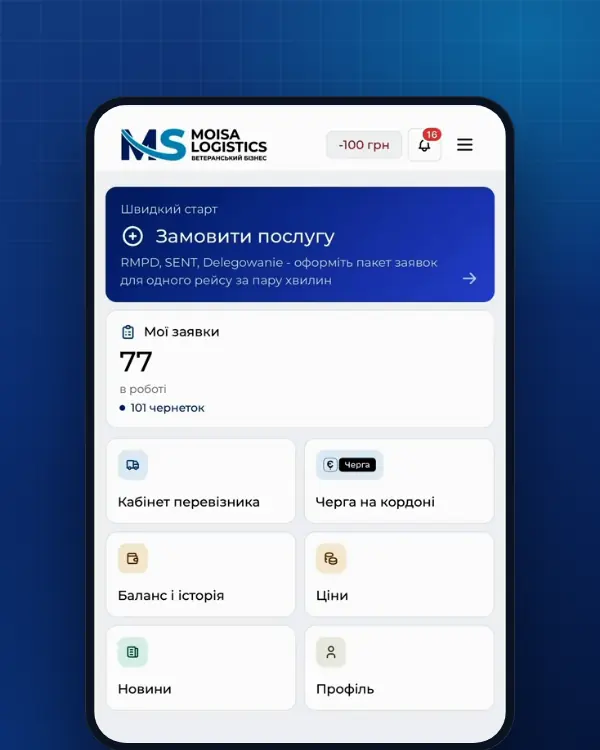
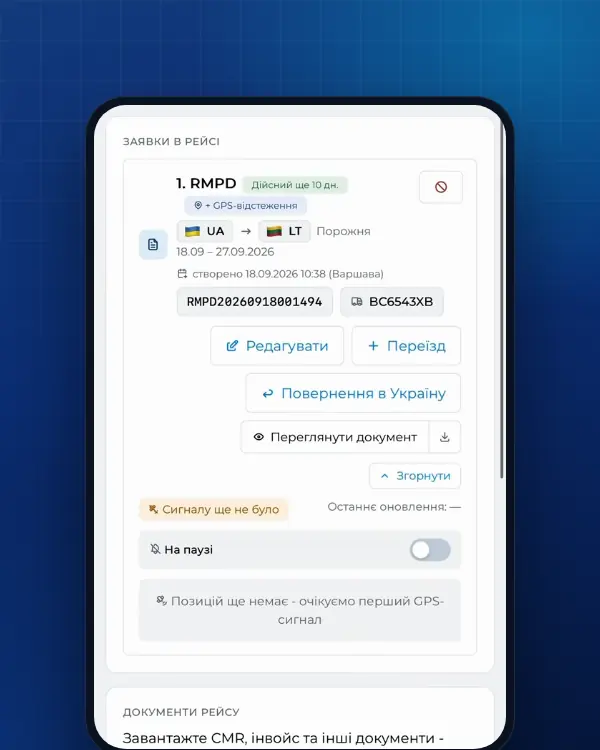
In the Moisa Logistics account we prepare a paper CMR: you fill in fields that mirror the boxes of the form, check the draft and get a PDF with six copies to print. Filling it in yourself costs 0 UAH (CMR in the account); leave it to us for 250 UAH per note (CMR full service). Step by step with screenshots - “Fill in a CMR online for free”. The PDF is printed and signed, so it is a paper CMR that works on any route.
Who fills in what in the note and who is liable for mistakes - “Who fills in the CMR”; myths about stamps, copies and phone photos - “7 myths about CMR and TTN”; what a driver can show on screen and what only on paper - “Driver documents on the phone”.
Frequently asked questions
Sources
- Additional Protocol to the CMR Convention concerning the Electronic Consignment Note, Geneva 20.02.2008 - English text (Tractatenblad 2008, 130), art. 1-6checked 21 November 2026
- UN Treaty Collection - Additional Protocol to the CMR concerning the Electronic Consignment Note (XI-B-11-b): 42 parties, Ukraine 10.07.2020, Poland 13.06.2019, Romania 14.03.2019, Moldova 14.03.2018 (status at 21.11.2026)checked 21 November 2026
- UN depositary notification C.N.291.2020 - Ukraine: accession to the e-CMR Protocol, in force for Ukraine from 08.10.2020checked 21 November 2026
- Protokół dodatkowy do Konwencji CMR dotyczący elektronicznego listu przewozowego (Dz.U. 2019 poz. 1487), w życie od 11.09.2019checked 21 November 2026
- UNECE SC.1 - Guidance note on the legal aspects of e-CMR, ECE/TRANS/SC.1/2018/1/Rev.1 (29.07.2019): para. 31 (printed version on board), 33-36 (statement in the note, one of the origin or destination countries a party, voluntary use)checked 21 November 2026
- Regulation (EU) 2020/1056 on electronic freight transport information (eFTI): Art. 2(1), 4, 5(1), 18, recital 23checked 21 November 2026
- European Commission - Towards paperless freight transport: first eFTI implementing and delegated acts in force (09.01.2025); authorities must accept eFTI data from 9 July 2027checked 21 November 2026
- Council of the EU - Agreement between the EU and Ukraine amending the Agreement on the carriage of freight by road (ST 10783/24): Art. 5a - certified copy or extract of the authorisation in paper format, Art. 5b - contract or carriage request for unladen journeys, evidence electronically (e-CMR), Art. 5c - stickerchecked 21 November 2026
- ONZ - Konwencja o umowie międzynarodowego przewozu drogowego towarów (CMR), Genewa 19.05.1956checked 21 November 2026
Need documents for a trip?
Create a free account and prepare the document in your account - by yourself or with our team’s hands. Or leave a request: we will call you and tell you what you need for your particular trip.
More news


We are on TikTok
How to prepare documents from your phone, what is changing for carriers and where to save - in short videos.